
Our Work
What We Do

Detroit Equity Action Lab (DEAL)
The Detroit Equity Action Lab works to co-create a multiracial and multigenerational network of racial equity leaders and equip them with tools to disrupt racism and create equitable alternatives together. The lab offers a year-long fellowship program for emerging and experienced leaders with a deep commitment to racial equity. You can learn more about the fellowship here.

Democracy Media Lab
The Damon J. Keith Center pursues community journalism as one of the strategic pillars through which we advance civil rights work in Detroit and beyond. We understand journalism as a form of civic infrastructure and how communities understand themselves, hold institutions accountable, and contest the narratives that shape political possibility. Our flagship program, the Democracy Media Lab aims to support and produce journalism that treats Detroit and its diasporic communities as analytic resource, is rigorous about race, history, and structural power, and centers the perspectives of those most affected by the issues at stake. DML refuses the deficit framing through which national media renders Black and immigrant cities legible. DML’s current initiative, VERDAD, takes up this work in a domain that has long evaded serious civic scrutiny, the terrain of Spanish-language radio. Radio is one of the most trusted and influential information sources in Latino communities and one of the most consequential sites at which public narrative is shaped, contested, and distorted. By monitoring, transcribing, and translating radio broadcasts, VERDAD turns audio into searchable insights that journalists, researchers, and community organizations can use to investigate what is being said on air and how those narratives travel. The premise of VERDAD is that transparency is a precondition for accountability. Understanding what is being said in a community's most trusted information channels is the first step toward protecting the integrity of public dialogue.
Damon J. Keith Collection
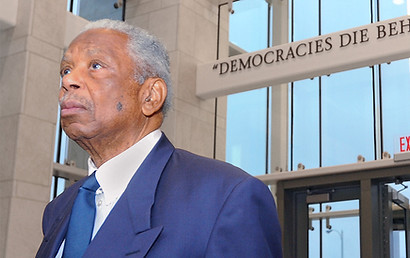
The Damon J. Keith Collection of African American Legal History and the artifacts of Judge Keith's chambers represent one of the most significant repositories of civil rights memory in the Midwest, and they belong to Detroit. Yet archives only fulfill their purpose when they are alive, when they are accessed, studied, taught, debated, and used to make sense of the present. This priority is premised on the conviction that Judge Keith's legacy continues in the struggle for justice. By expanding engagement with the Collection, transforming chamber artifacts into civic education tools, and securing a permanent home for the Marching Towards Justice exhibition, we are ensuring that the history of the freedom struggle in Detroit remains a source of power, not just memory, for the next generation of movement builders.

Movement Law
The Damon J. Keith Center understands movement lawyering as a discipline that refuses the conventional limits of legal practice — one that asks lawyers and legal organizations to do more than win cases and treats the law itself as terrain to be reimagined rather than infrastructure to be defended. Our work in this area aligns with what the field has come to articulate as four interlocking commitments: transforming the legal sector by training lawyers to build collective power alongside the communities they represent; building durable legal infrastructure for grassroots-led progressive movements; reimagining law as a living practice that can be democratized and deployed in service of self-determination; and organizing lawyers into a sustained force for multiracial democracy. Through movement lawyering we honor Judge Damon J. Keith's legacy in the present civic and legal conditions by ensuring that the law remains accountable to the people it claims to serve, and by building the kind of legal practice that a democratic future will require.

Democracy & Civic Power
Our orientation to Democracy is municipalist. We take the city, Detroit in particular, as the unit at which democracy is most concretely lived, most acutely contested, and most available to be transformed. National political discourse renders the city as a site of consequence rather than a site of theoretical production, a place where federal and state decisions land rather than a place where democratic life is itself reimagined. At the Center, we understand the city as the place where the abstractions of democratic theory meet the material conditions of housing, policing, education, transit, and public space; where ordinary people make and remake the institutions that govern them; and where the gap between the formal rights the law extends and the substantive power those rights are meant to secure becomes most visible and most addressable. The work of this pillar is to take that premise seriously by investing in civic education that treats Detroiters as political thinkers, to support the infrastructures through which residents exercise voice and shape decisions about the conditions of their own lives, and to build the analytic and organizing capacity through which the city itself becomes a site of democratic reconstruction. We believe this is the present form of Judge Damon J. Keith's central conviction that the work of democracy is unfinished, and that a city like Detroit is precisely the kind of place where its future is being decided.